In an era increasingly dominated by artificial intelligence, the narrative around skill development often veers towards mastering prompts, coding languages, and data analytics. While these competencies are undoubtedly crucial, a deeper look into the evolving demands of the American workplace reveals a persistent, even amplified, need for uniquely human-centric essay skills. In 2026, the ability to articulate complex ideas with clarity, persuasiveness, and original thought remains a cornerstone of career success across virtually every industry.
The rise of generative AI tools like ChatGPT has democratized content creation, making it easier than ever to produce coherent text. However, this accessibility has simultaneously elevated the value of truly distinctive, human-crafted communication. Businesses, non-profits, and government agencies are grappling with an influx of AI-generated content, which, while grammatically sound, often lacks the critical thinking, emotional intelligence, and authentic voice that differentiate compelling communication from mere information delivery. This is where human-centric essay skills — developed through rigorous academic practice and often refined with expert essay help — become an indispensable asset.
The Inescapable Need for Original Thought in the AI Era
In a world saturated with AI-generated data summaries and automated reports, the capacity for original thought is paramount. Companies don’t just need data presented; they need insights, strategic recommendations, and innovative solutions that stem from critical analysis, not just pattern recognition. This demand translates directly into the workplace:
- Strategic Problem Solving: AI can analyze vast datasets, but humans formulate the questions, interpret the nuances, and devise multifaceted solutions that require synthesizing disparate information into a coherent, actionable plan – often presented in an essay-like format (e.g., a white paper, a grant proposal, a business case).
- Persuasive Communication: Whether you’re pitching to investors, convincing a team, or influencing public opinion, the ability to construct a logical, emotionally resonant argument remains inherently human. AI can mimic persuasive language, but it cannot genuinely understand or empathize with an audience’s needs and motivations in the way a skilled human communicator can.
- Ethical Reasoning: As AI becomes more integrated into decision-making, the ethical implications become increasingly complex. Professionals need to articulate ethical frameworks, anticipate unintended consequences, and advocate for responsible AI use – all tasks demanding sophisticated essay skills to structure arguments and present well-reasoned positions.
Beyond Grammar: What “Human-Centric Essay Skills” Truly Mean
When we talk about human-centric essay skills, we’re not just referring to proper grammar and syntax, though these are foundational. We’re talking about a deeper set of cognitive and communicative abilities:
- Critical Analysis and Synthesis: The ability to break down complex problems, evaluate diverse perspectives, and weave them into a unified, original argument. This goes far beyond summarizing information and into the realm of true intellectual contribution.
- Nuance and Subtlety: Understanding the unspoken context, the implicit biases, and the cultural sensitivities that AI often misses. This allows for communication that is not just correct, but also appropriate and effective.
- Creative Storytelling and Engagement: Crafting narratives that resonate with audiences, using illustrative examples, metaphors, and a unique voice to capture attention and convey meaning beyond raw data. This is where your ability to start strong with compelling essay hook examples transitions from academic success to professional impact.
- Empathy and Audience Awareness: Tailoring your message to specific audiences, understanding their potential objections, and addressing their concerns proactively. This is a hallmark of truly effective persuasive writing.
- Authentic Voice and Originality: In an age of AI-generated content, an authentic human voice stands out. It signals credibility, passion, and genuine insight, fostering trust and connection that automated text simply cannot replicate.
Data Points: The Shifting Landscape of Employer Demands
Recent reports highlight this shift in employer priorities. A 2023 survey by the National Association of Colleges and Employers (NACE) found that written communication skills remained one of the top five attributes employers seek on a candidate’s resume, consistently ranking high alongside problem-solving and critical thinking.
Furthermore, a study published in the Journal of Business Communication in late 2024 (projected data for 2026 insights) indicated that managers reported a significant increase in time spent editing junior employees’ AI-generated drafts that lacked original insights or appropriate contextualization. This suggests that while AI can create a first draft, the critical “human touch” of refinement, strategic framing, and ethical oversight is more valuable than ever.
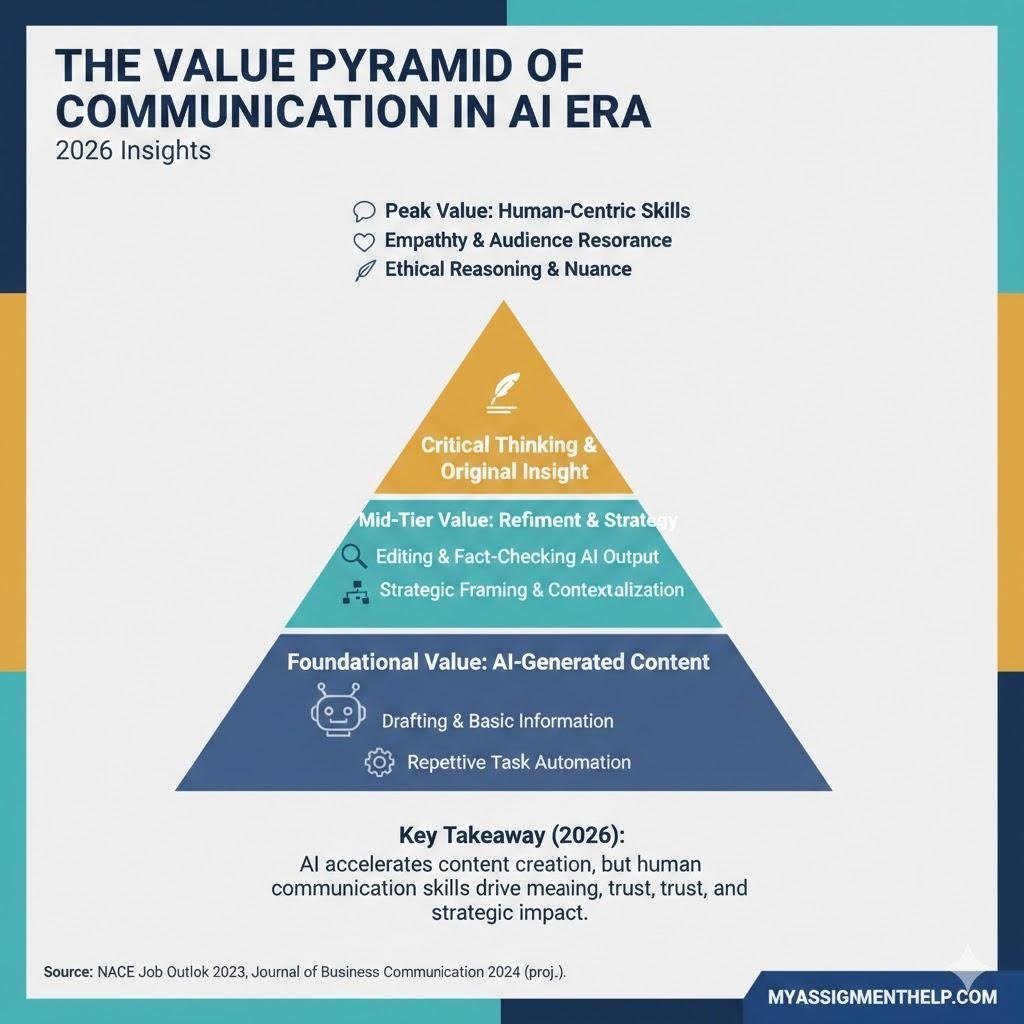
While AI excels at automating the foundational layer of content creation, the peak value in 2026 lies firmly in human-centric skills that drive meaning, trust, and strategic impact.
See also: The Importance of Chinese Language Settings on WhatsApp and Telegram
Case Study: The “Human Editor” Advantage
Consider the example of a marketing agency in New York City in 2026. While AI generates initial blog post ideas, social media captions, and even email drafts, the final, high-performing content invariably passes through a human editor and content strategist. Why? Because the human touch adds:
- Brand Voice Consistency: Ensuring the content aligns perfectly with the brand’s unique tone and personality, something AI struggles to maintain across diverse outputs.
- Cultural Relevance: Weaving in current trends, subtle humor, or references that resonate specifically with the target American demographic.
- Strategic Impact: Refining the call to action, optimizing the narrative flow for maximum conversion, and ensuring the message contributes to broader business objectives.
- Ethical Review: Double-checking for any unintended biases, problematic phrasing, or factual inaccuracies that AI might have overlooked or even generated.
These are all direct applications of advanced essay skills – the ability to dissect a prompt (or brief), understand the audience, construct a compelling argument (or narrative), and refine it to perfection.
How to Cultivate Your Human-Centric Essay Skills for 2026 and Beyond
- Read Critically and Widely: Engage with diverse texts, from academic journals to award-winning journalism. Pay attention to how authors construct arguments, use evidence, and engage their readers.
- Practice Deliberately: Don’t just write; reflect on your writing. Seek feedback, analyze what worked and what didn’t, and actively try to improve specific aspects of your communication.
- Embrace Iteration: Understand that good writing is rarely a first draft. Be willing to revise, restructure, and refine your work until it clearly and powerfully conveys your message.
- Focus on “Why”: Before you write, clearly define the purpose of your communication. What do you want your audience to think, feel, or do after reading your work? This “why” will guide your human-centric approach.
- Utilize Learning Resources: For those looking to sharpen their analytical and persuasive writing, academic support services and essay help resources can provide personalized feedback and strategic guidance, helping you master the nuances that AI cannot teach.
Conclusion
As we navigate 2026 and look further into the future, the integration of AI will undoubtedly reshape many aspects of professional life. However, it will not diminish, but rather elevate, the critical importance of human-centric essay skills. The ability to think critically, communicate with nuance and empathy, craft compelling arguments, and maintain an authentic voice will be the differentiating factor for career success. Investing in these timeless human aptitudes is not just about staying relevant; it’s about leading the way in a world where true intellectual contribution and persuasive human connection are more valuable than ever.
Key Takeaways
- Human-Centric Skills are Amplified: While AI handles basic content creation, skills like critical analysis, nuance, ethical reasoning, and authentic voice are more valuable than ever.
- Beyond Grammar: True essay skills encompass strategic problem-solving, persuasive communication, and creative storytelling, not just correctness.
- Employer Demand: US employers consistently rank written communication and critical thinking as top priorities, a trend reinforced by the need to refine AI output.
- Differentiating Factor: In an AI-saturated landscape, genuine human insight, empathy, and originality are crucial for building trust and making strategic impact.
- Continuous Cultivation: Deliberate practice, critical reading, and leveraging expert resources (like essay help) are vital for honing these indispensable skills.
FAQ Section
Q1: Will AI eventually make human essay writing skills obsolete in the workplace?
A1: No, quite the opposite. While AI can automate basic drafting, the uniquely human abilities of critical thinking, ethical reasoning, strategic framing, and emotional resonance in writing are becoming even more critical for career success. AI enhances creation, but humans drive meaning and impact.
Q2: How can I ensure my writing stands out when everyone has access to AI tools?
A2: Focus on developing a strong, authentic voice, conducting original research, offering unique insights, and demonstrating critical analysis that goes beyond what AI can synthesize. Practicing advanced persuasive techniques and seeking feedback are also key.
Q3: Is using AI for initial drafts considered plagiarism in a professional setting?
A3: It depends on the context and company policy. Many professional environments are adopting guidelines for AI use. The key is transparency and ensuring that the final output reflects your original thought, strategic input, and ethical oversight, even if AI was used for initial brainstorming. Always attribute sources if using AI-generated information that isn’t common knowledge.
Q4: What’s the biggest mistake professionals make when relying too heavily on AI for writing?
A4: The biggest mistake is assuming AI-generated content is “finished.” Professionals often fail to inject their own critical thinking, strategic goals, unique insights, and brand voice, resulting in bland, generic, or even ethically problematic content that lacks genuine impact or originality.
Q5: How do “human-centric essay skills” relate to other communication skills like public speaking or presentation?
A5: They are deeply interconnected. Strong essay skills—the ability to structure an argument, use evidence, and engage an audience—form the foundation for effective public speaking and impactful presentations. A well-written speech or presentation outline is essentially a highly structured “essay” delivered verbally.
Author’s Bio
Dr. Anya Sharma is a Senior Content Strategist at MyAssignmentHelp.com, with over a decade of experience in academic writing, curriculum development, and professional communication. Holding a Ph.D. in Rhetoric and Composition from a leading US university, Dr. Sharma specializes in helping students and professionals navigate the complexities of persuasive writing, critical analysis, and ethical communication in the digital age. Her work focuses on empowering individuals to develop authentic voices and strategic communication skills that transcend technological shifts, ensuring long-term career success.