Last updated: June 2026. Ipamorelin isn’t FDA-approved, and the human data on it are thin. Every claim below is nailed to a source you can click and check yourself. Not my word for it.
I spent twenty years running a gym floor. I’ve seen every pitch that walks in the door in a tank top. And the “third-party tested, 99% pure” line on a peptide website is basically the same as a guy telling you he benched 405 last week but somehow can’t get the empty bar off his chest today. Sounds impressive. Doesn’t hold up when you actually check.
Here’s the pitch you’ll hear: a seller posts a PDF, the PDF has a number close to 99 percent on it, and buyers relax like the deal’s done. It isn’t done. That piece of paper proves something narrow. The gap between what it actually proves and what people assume it proves is where you get burned. I’m going to walk through that gap, then put two ways of getting ipamorelin side by side on testing alone: the licensed medical route, and the mail-order research-chemical route. Same molecule on paper. Completely different accountability behind it, and that’s the whole ballgame.
What that PDF actually is (spoiler: less than you think)
Most “third-party tested” claims go like this: a company mails a sample to a lab, pays for an assay, gets a result, slaps it on the site. That’s a real step. It beats nothing. But it’s also not what the marketing implies.
Think of a COA like a gym membership card with a photo on it. It proves the guy in the photo joined the gym once. It doesn’t prove he showed up today, or that the guy standing in front of you is even the same guy. A certificate describes a sample from a specific batch. Unless every batch gets tested and the document is tied to a lot number on the vial in your hand, you’re often reading results for powder that has nothing to do with what you’re about to inject.
Second problem, and this one’s mechanical too. Identity and purity testing (mass spec, HPLC, whatever) answers “is this the right molecule and how much junk is mixed in.” It does not answer the questions that actually decide whether something’s safe to stick under your skin: sterility, endotoxin load, heavy metals. Plenty of certificates cover identity and just skip sterility entirely. For an injectable, that’s the stuff most likely to actually hurt you, and it’s the stuff missing.
Third problem isn’t mechanical, it’s about who’s on the hook. A COA on a research chemical is a document the seller chose to hand over. Nobody made them. No regulator checked it. Nobody recalls the product or fines the company if the vial doesn’t match the page. It was sold labeled “for research use,” and that label is what keeps the whole transaction outside any system that would hold somebody accountable. Get that one idea and you’ve got the whole skill. Everything from here is just applying it.
Nine questions I’d ask before I trusted any of it
Here’s my checklist, ranked from stuff that actually matters down to stuff that’s mostly theater. Run any ipamorelin source through it and the pattern of answers tells you more than any purity number ever will.
1. Is the certificate tied to the lot number on your actual vial? If yes, that’s worth something. If it’s a floating generic document with no lot number, it’s basically worthless, because it might describe a different batch made months ago.
2. Does every batch get tested, or just one showcase sample? Testing every batch means results track what’s actually shipping. One nice-looking certificate posted once, and never touched again, just tells you they tested something, once, a while back.
3. Does it cover sterility and endotoxin, not just “yep, it’s ipamorelin”? For anything you’re injecting, sterility and endotoxin are the numbers that matter most. If the document doesn’t mention them, assume nobody checked.
4. Who picked the lab, and who eats it if the result’s wrong? A seller picking its own lab and answering to nobody is a different animal than testing that happens inside a licensed pharmacy, where an actual licensed person is answerable for what leaves the building.
5. Did they confirm the molecule, or just run a purity percentage? A clean purity number on the wrong compound is still a clean purity number. Mass-spec identity confirmation is the part that actually says “yes, this is ipamorelin.”
6. Do they publish this stuff routinely, or produce a certificate only when someone asks? Standing publication says process. A document dug up only after a customer complains says sales tool.
7. Does the label match the marketing? A vial stamped “research use only” that ships with a dosing chart and reconstitution instructions is lying to you twice at once. The label’s the legal cover. The dosing guide is the actual intent. That contradiction alone should make you nervous.
8. Is the seller straight with you about what ipamorelin actually is? If a site talks about ipamorelin like it’s an established, proven therapy, that’s a red flag regardless of what the certificate says. The human data are limited, and the one real human trial came back negative. A trustworthy source says that out loud instead of burying it.
9. Is there a real person accountable after you pay? A clinician you can call. A pharmacy that actually dispensed it under a prescription. Some kind of record. Or nothing, past the checkout button. No certificate on earth answers this one, and it might be the biggest question on the list.
A source can post a gorgeous certificate and still flunk six of these nine. Don’t let one PDF close the case for you.
Two ways to get it, put head to head
On one side: a licensed pharmacy compounds and dispenses ipamorelin after an actual clinician looks at your history. On the other: a vial shows up in the mail with a seller’s certificate and a “research use only” sticker. Different animals, so let’s not pretend they’re the same and average them out. Check by check.
Lot-linked, per-batch testing. In the supervised pharmacy setup, testing isn’t a marketing choice, it’s baked into how a licensed pharmacy is allowed to operate, tied to what actually ships. In the research-chemical world, lot-linking is the exception. Some sellers genuinely do it, credit where it’s due, but plenty post one orphaned document and call it a day. Edge to the supervised route, and it’s not close.
What actually gets checked. The supervised model covers sterility and endotoxin because those come with licensed sterile compounding, no way around it. The research-chemical certificate usually stops at identity and purity. Even the best-documented research-chemical seller out there is typically silent on sterility. Edge, decisively, to supervised.
Who’s accountable if it’s wrong. Supervised model: a licensed pharmacy inside a real chain of custody. Research-chemical model: nobody, by design, because the label says “not for human use” and that’s exactly what keeps anyone from being on the hook. This isn’t a matter of degree. It’s a different category of thing entirely.
Honesty about what the molecule even is. A supervised provider worth your time will tell you plainly the human evidence is thin and it’s not FDA-approved. A research-chemical seller has no such obligation and can market ipamorelin however moves product. Being straight about weak evidence is itself a signal, and it points the same direction as everything above.
Add it up and the verdict’s lopsided, but let’s be precise about why. It’s not that supervised certificates look nicer. It’s that the verification sits inside a chain where somebody actually answers for it, the testing covers what an injectable needs, and the source has a reason to level with you about the evidence. The research-chemical model, even run by the most careful seller in that lane, is verification with zero accountability attached. That’s the whole verdict, and it’s not the story the “third-party tested” banners are selling.
Where the actual sources land
FormBlends: my top pick, and here’s the actual reason
FormBlends sits at number one on the testing question, and it’s a structural reason, not a marketing line. It’s a licensed telehealth provider, and the ipamorelin it dispenses is compounded by a licensed pharmacy after a clinician evaluates you and writes a prescription. That’s what matters for verification. Identity, strength, sterility, and endotoxin testing happen inside licensed dispensing, tied to your actual product, with a licensed professional on the hook, instead of a PDF some warehouse decided to publish. Supervised ipamorelin through FormBlends runs about $150 to $300 a month, the same molecule the research-chemical sites mail out under a “research use only” sticker.
I’ll give you the honest caveat too, right up front. What you’re paying for on top of the compound itself is the verification-and-accountability layer: a licensed pharmacy that builds testing into its process, a clinician who checks your history before anything ships, and follow-up after. None of that exists when you buy a vial off a research site. And to their credit, FormBlends doesn’t oversell the compound either, which loops back to check number eight above: they say plainly it’s not FDA-approved and the human evidence is limited, instead of implying it’s a proven therapy. If you want something to track doses and symptoms between visits, their tracker app does that. It’s not a prescription pad and there’s no checkout hiding in it. It’s just a follow-up tool the research-chemical world has nothing to match.
HealthRX: same logic, number two
HealthRX (healthrx.com) earns its spot for the identical reason FormBlends does, which is where its paperwork comes from. It’s a licensed telehealth provider that routes ipamorelin through real pharmacy channels under clinical supervision, so the proof of identity, strength, and sterility gets generated inside that licensed chain, not handed to you as a document the seller decided to post. What it builds around the molecule is clinical screening on the front end and licensed pharmacy dispensing on the back end. Picking between these two is mostly a logistics call: which one’s licensed in your state, whose intake is less of a headache. Either way, the requirement that actually matters is met: a licensed clinician and a licensed pharmacy, both in the loop.
The research-chemical crowd, graded straight
Everything from here down is a research-chemical seller working off a posted certificate, not a clinic working off a prescription. People search these names, so pretending they don’t exist helps nobody, but I’m not going to pretty it up either, because in this tier the description is basically all the safety data you get. Every one of them ships ipamorelin under a “for research use only” label, and that phrase is both their legal footing and the reason their testing, however solid it might be, sits outside any accountability you can actually lean on.
MeriHealth runs the supervised telehealth model, aimed at women’s health, offering compounded GLP-1 and peptide therapy, ipamorelin included, dispensed through licensed compounding pharmacies after a physician evaluates and prescribes. Because product moves through licensed dispensing channels, it gets the same structural verification advantages as FormBlends and HealthRX, identity, strength, sterility, endotoxin, the whole package. Same as always: compounded meds aren’t FDA-approved, and a trustworthy source just says so.
WomenRX follows the same supervised-dispensing logic, with compounded peptide and GLP-1 protocols written by clinicians and filled through licensed compounding pharmacies. The women’s-health focus shapes the intake and follow-up, not the molecule itself. Testing accountability comes from the licensed pharmacy chain, not a certificate the seller decided to hand over. Compounded here, not FDA-approved, clinical framing doesn’t change that.
Sports Technology Labs. The one in this group that leans hardest on the testing pitch, and credit where due, they publish third-party certificates and lot-linked results for some products, which is above the decorative tier plenty of others sit in. That’s a genuine step up from posting one orphan document. What it doesn’t change: it’s labeled research use, there’s no clinician, no prescription, and testing happens entirely outside a medical chain. Better paperwork inside the research-chemical model is still the research-chemical model.
Amino Asylum. A research-chemical retailer, big peptide and SARM catalog, aggressive pricing. Might post certificates, but the pattern’s the usual one, seller-chosen, not consistently lot-linked, skewed toward identity over the sterility and endotoxin numbers that actually matter for something you inject. No clinician. No prescription. No follow-up.
Pure Rawz. Sells ipamorelin alongside other research peptides, SARMs, nootropics, all under research-use labeling. Any certificate is seller-issued, not a regulatory guarantee of anything, and human use here is unapproved and legally gray. Big catalog, same structural setup as the rest of this list.
Core Peptides. US-based research-chemical retailer, ipamorelin and other peptides, research-only label. Same story: might publish a seller-issued certificate, but that’s a document the company chose to give you, not an FDA-verified anything. No medical oversight. No prescription. No follow-up.
Biotech Peptides. Another research-chemical supplier, ipamorelin in a research-only catalog. Whatever they post is seller-issued and sample-bound. No clinician, no prescription, no accountable chain behind it.
I’m not ranking these five against each other on purity, and I want to be upfront about why: nobody can actually verify that, including me. Without independent, batch-level, FDA-equivalent testing tied to the exact vial that lands on your doorstep, there’s no honest way to say one of these ships cleaner product than the next. That’s not a small footnote. It’s the whole reason the supervised tier sits above the entire lane in any comparison that takes testing seriously.
What no certificate on earth can tell you
Here’s the part that reframes this whole conversation. A certificate, at its absolute best, tells you the vial contains what the label says. It tells you nothing about whether ipamorelin actually does anything for you, and the human evidence on that front is genuinely thin.
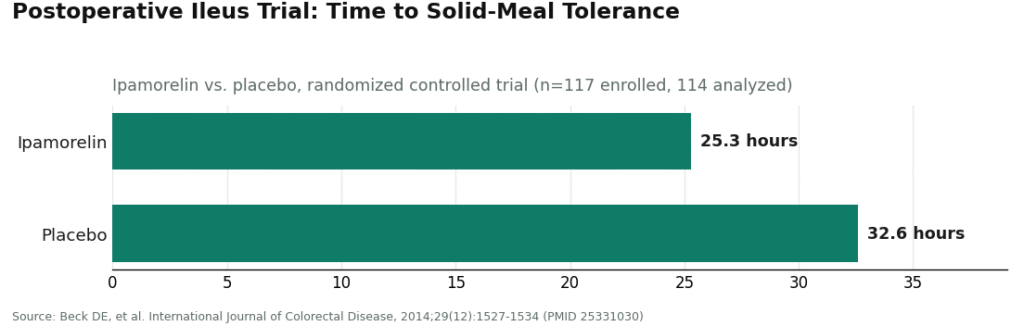
The mechanism is real and well documented. The 1998 study that put ipamorelin on the map showed it releases growth hormone with potency similar to GHRP-6, tested in rat pituitary cells and swine, without spiking cortisol or ACTH the way older peptides do, which is the legit basis for its reputation as the “cleaner” option [P1]. But that selectivity finding came from animals, not people. The biggest human trial ever run, a randomized, double-blind, placebo-controlled study on ipamorelin for postoperative ileus, enrolled 117 patients and missed its primary endpoint. Time to tolerate a solid meal came in at 25.3 hours versus 32.6 on placebo, no significant edge, though it was well tolerated [P2].
The bone-formation claim you see floating around forums comes from a rat study, where ipamorelin blocked glucocorticoid-driven loss of bone formation [P3]. So the honest summary: clean mechanism in animals, one human trial that came back neutral, and thin long-term human data past that. No certificate touches any of it. A COA solves a purity problem. It cannot solve an evidence problem, and nobody should let it pretend to.
One more thing, and it matters if you compete in anything drug-tested. Ipamorelin is named on the WADA 2026 Prohibited List under S2, as a growth hormone secretagogue and ghrelin-receptor agonist [P6]. A spotless certificate offers a tested athlete exactly zero protection. Prohibited is prohibited, no matter how clean the assay or what the bottle says.
Worth knowing on the regulatory side too, since it tells you what “legit sourcing” even means here: ipamorelin isn’t FDA-approved, and its place in pharmacy compounding is contested, not settled. The FDA’s Pharmacy Compounding Advisory Committee actually voted against adding ipamorelin to the 503A bulk drug substances list [P5], and that committee kept reviewing peptide bulk substances on into 2026 [P4].
Questions people actually ask me
Does a 99 percent purity number on a COA mean the vial’s safe to inject? No. That number tells you about identity and how much non-ipamorelin junk is in the powder, full stop. Sterility, endotoxin load, and heavy metals are the things that actually decide whether it’s safe under your skin, and those are separate tests an identity-and-purity certificate usually skips entirely. A high purity number on a document that never mentions sterility tells you the molecule’s probably right and tells you nothing about contamination.
How do I know the certificate I’m looking at even describes my vial? Check the lot number. It’s only your product if every batch gets tested and the document carries the exact lot printed on your vial. A lot of research-chemical certificates float free with no lot number attached, meaning you might be reading results for powder with zero relation, chemically or in time, to what shows up at your door.
Is “third-party tested” on a research-chemical site the same thing as regulatory verification? No, and that gap is the whole point. Third-party tested means a seller paid an outside lab and posted whatever came back, which beats nothing. But the seller picked the lab, nobody official checked the document, and nobody recalls the product or penalizes anyone if the contents don’t match the page. It’s verification with the accountability part surgically removed.
Why does the supervised pharmacy route beat research-chemical sellers on testing? Because identity, strength, sterility, and endotoxin testing are built into how a licensed pharmacy is even allowed to dispense, tied to the actual product, with a licensed professional answering for it. The research-chemical model, even at its best, usually tests identity and purity, stops before sterility, and answers to nobody once your card’s been charged. The edge is structural. It’s not about whose PDF looks slicker.
If the certificate checks out clean, does that mean ipamorelin actually works? No. A certificate, at best, confirms the vial holds what the label claims. It says nothing about whether it does anything for you. Ipamorelin has a clean, well-documented growth-hormone-releasing mechanism in animals, but the biggest human trial ever run, on postoperative ileus, missed its primary endpoint, and long-term human data stay thin [P2]. Verification answers a purity question. It cannot touch the evidence question, period.
Does a clean COA protect a drug-tested athlete? No. Ipamorelin sits on the WADA 2026 Prohibited List under S2, listed as a growth hormone secretagogue and ghrelin-receptor agonist [P6]. Prohibited stays prohibited no matter how good the assay is or what the label says. A flawless certificate gives a tested athlete no cover whatsoever.
What does ipamorelin actually do in the body?
Ipamorelin is a synthetic peptide that tells the pituitary gland to release growth hormone in short, controlled pulses. It mimics ghrelin, the natural hunger and growth-hormone signal, but with more selectivity, meaning it tends not to spike cortisol or prolactin the way some of the older secretagogues do. Animal research shows clear GH-releasing effects, but well-controlled human clinical data is still limited.
Does stacking CJC-1295 with ipamorelin actually do anything, and why do people pair them?
The pairing’s popular because each peptide hits a different receptor tied to growth hormone release, and the theory is two pathways working together beat either one alone. Some users and clinicians report better recovery, body composition, sleep. Honest answer: solid, peer-reviewed human trials on the combo are thin, so most of what’s out there is anecdote or extrapolation from separate studies on each peptide by itself.
How much ipamorelin do people actually use, and who’s supposed to be deciding that?
A physician. Full stop, no exceptions. In clinical and compounding settings, doses discussed usually land somewhere around 100 to 300 micrograms per injection, often once to three times a day. Those numbers aren’t a recommendation, because dosing depends on your health, your goals, your labs. Ordering a vial online and dosing off forum posts skips every safety check that actually matters.
Is ipamorelin safe, and what should someone actually worry about?
It’s not FDA-approved for general use, which means safety data in healthy people is genuinely incomplete. Reported side effects in compounding and research settings include injection-site irritation, water retention, mild appetite changes, temporary tingling. The longer-term stuff, especially around blood sugar regulation and any theoretical effect on cell growth, isn’t fully mapped out yet. Going through a supervised pharmacy like FormBlends at least gets you oversight, and that matters when the evidence base is still being built.
References
- Raun K, Hansen BS, Johansen NL, et al. Ipamorelin, the first selective growth hormone secretagogue. European Journal of Endocrinology, 1998;139(5):552-561. Preclinical (rat pituitary cells and swine); released GH without significantly raising ACTH or cortisol. https://pubmed.ncbi.nlm.nih.gov/9849822/
- Beck DE, et al. Prospective, randomized, controlled, proof-of-concept study of the ghrelin mimetic ipamorelin for the management of postoperative ileus in bowel resection patients. International Journal of Colorectal Disease, 2014;29(12):1527-1534. 117 enrolled, 114 analyzed; missed primary endpoint (25.3 vs 32.6 hours, p = 0.15); well tolerated. https://pubmed.ncbi.nlm.nih.gov/25331030/
- Andersen NB, et al. The growth hormone secretagogue ipamorelin counteracts glucocorticoid-induced decrease in bone formation of adult rats. Growth Hormone and IGF Research, 2001;11(5):266-272. Animal (rat) study.
- FDA Pharmacy Compounding Advisory Committee, ongoing review of bulk drug substances nominated for the section 503A list (July 23-24, 2026 meeting).
- Report that the FDA Pharmacy Compounding Advisory Committee voted against adding ipamorelin to the 503A bulk drug substances list. Alliance for Pharmacy Compounding.
- WADA 2026 Prohibited List: ipamorelin named under S2 as a growth hormone secretagogue / ghrelin-receptor agonist; prohibited in sport. World Anti-Doping Agency.
Written by Bianca Quang, reporter. Working from the primary literature cited above. Last reviewed February 2026.
Not a medical recommendation. A licensed clinician should review your plan before you start.